Introduction: The New Pressure on Tech Teams
Today’s businesses are under constant pressure to move faster.
Customers expect rapid updates. Markets change overnight. Competitors launch new features every few weeks. In this environment, companies can no longer afford slow-moving technology teams or long hiring cycles.
But here’s the real challenge:
Most businesses are still trying to scale engineering teams using outdated methods.
They hire role by role. Build large departments. Add layers of management. Increase meetings. Expand processes.
And ironically, the bigger the team becomes, the slower delivery gets.
This is exactly why the POD model is becoming one of the fastest-growing approaches in modern IT delivery.
It helps companies scale smarter — without losing speed, flexibility, or cost efficiency.
What Is a POD Model in IT Services?
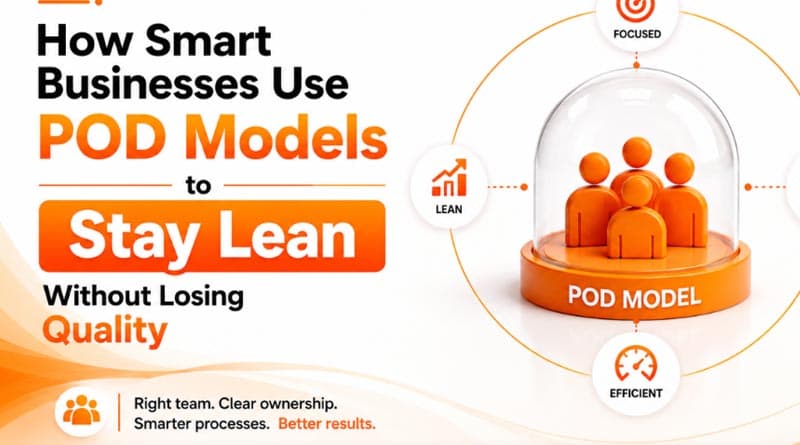
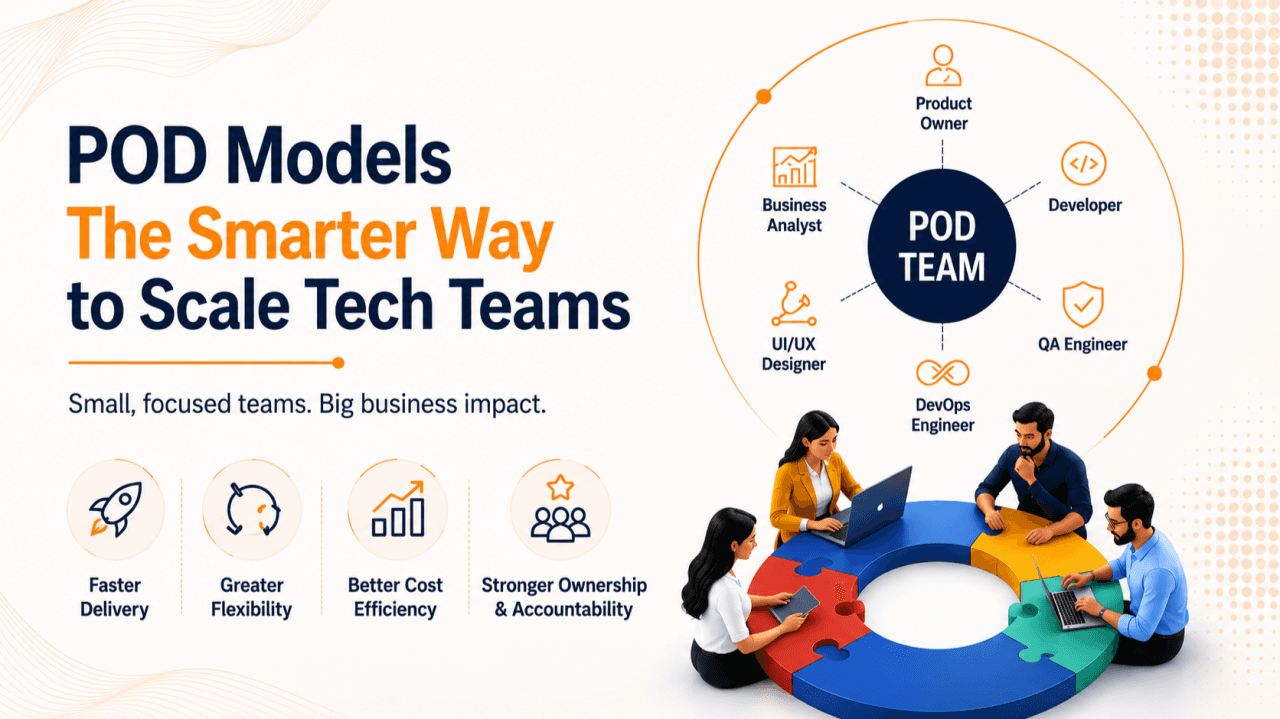
A POD is a small, cross-functional, self-managed technology team designed to own a specific product, feature, or business outcome.
Instead of separating developers, QA engineers, designers, DevOps specialists, and analysts into different departments, a POD brings them together into one focused unit.
Think of it as a mini startup inside a company.
Each POD is built to move independently, solve problems faster, and deliver outcomes with minimal dependency on external teams.
According to industry research, Agile POD teams improve scalability, productivity, and time-to-market because they reduce handoffs and increase ownership.
Why Traditional Team Scaling Is Slowing Businesses Down
Many organisations believe growth means adding more people.
But in reality, larger teams often create:
● More communication gaps
● Slower approvals
● Dependency bottlenecks
● Reduced accountability
● Longer release cycles
This creates what many leaders silently struggle with:
“Everyone is busy, but progress still feels slow.”
Research in Agile delivery consistently shows that smaller, self-organised teams perform better because decision-making becomes faster and collaboration improves.
Traditional scaling also creates another hidden issue: emotional disconnect.
When employees feel like tiny parts of a massive system, ownership naturally decreases.
People complete tasks.
But they stop feeling responsible for outcomes.
That difference changes everything.
How POD Models Improve Speed of Delivery
Speed is no longer a luxury in technology.
It is survival.
POD models accelerate delivery because the entire execution chain exists within one team.
There is no waiting for another department to respond. No excessive handoffs. No endless coordination loops.
The same people who design the solution also build, test, deploy, and improve it.
This dramatically reduces friction.
Studies on Agile POD frameworks show that organisations adopting POD-based delivery often achieve faster release cycles, higher stakeholder satisfaction, and improved productivity.
In practical terms, businesses benefit through:
● Faster product launches
● Quicker bug resolution
● Reduced development delays
● Better responsiveness to market changes
In highly competitive industries, even a few weeks of faster delivery can create a major business advantage.
How POD Models Increase Flexibility Without Chaos
One of the biggest myths in scaling technology teams is that flexibility creates disorder.
In reality, structured flexibility is what modern businesses need most.
POD models allow organisations to scale resources up or down quickly depending on project requirements.
Need to accelerate a product launch?
Add another POD.
Need to reduce development costs temporarily?
Resize the POD without disrupting the entire organisation.
Unlike traditional outsourcing models that may require months to restructure teams, POD structures are designed for adaptability. Some industry reports show that resource adjustments within POD models can happen significantly faster compared to traditional staffing approaches.
This flexibility becomes extremely valuable during:
● Rapid business growth
● Product pivots
● Seasonal demand spikes
● Startup scaling phases
● Enterprise transformation initiatives
The result is simple: Businesses remain agile without losing operational control.
How POD Models Help Control Costs More Effectively
One of the biggest misconceptions in IT scaling is that more employees automatically create more output.
Unfortunately, that is rarely true.
Larger disconnected teams often increase operational overhead rather than productivity.
POD models reduce this problem by creating learner, outcome-focused teams.
Instead of paying for idle coordination layers, businesses invest in compact teams that are directly aligned with delivery goals.
This improves:
● Resource utilization
● Delivery efficiency
● Budget predictability
● Operational transparency
Lean IT studies have shown that optimised delivery structures can significantly improve productivity while reducing execution waste.
For startups, this means preserving runway.
For enterprises, it means scaling innovation without uncontrolled hiring costs.
The Psychology Behind Why POD Teams Perform Better
This is where the conversation becomes truly interesting.
Technology delivery is not only about processes.
It is about human behaviour.
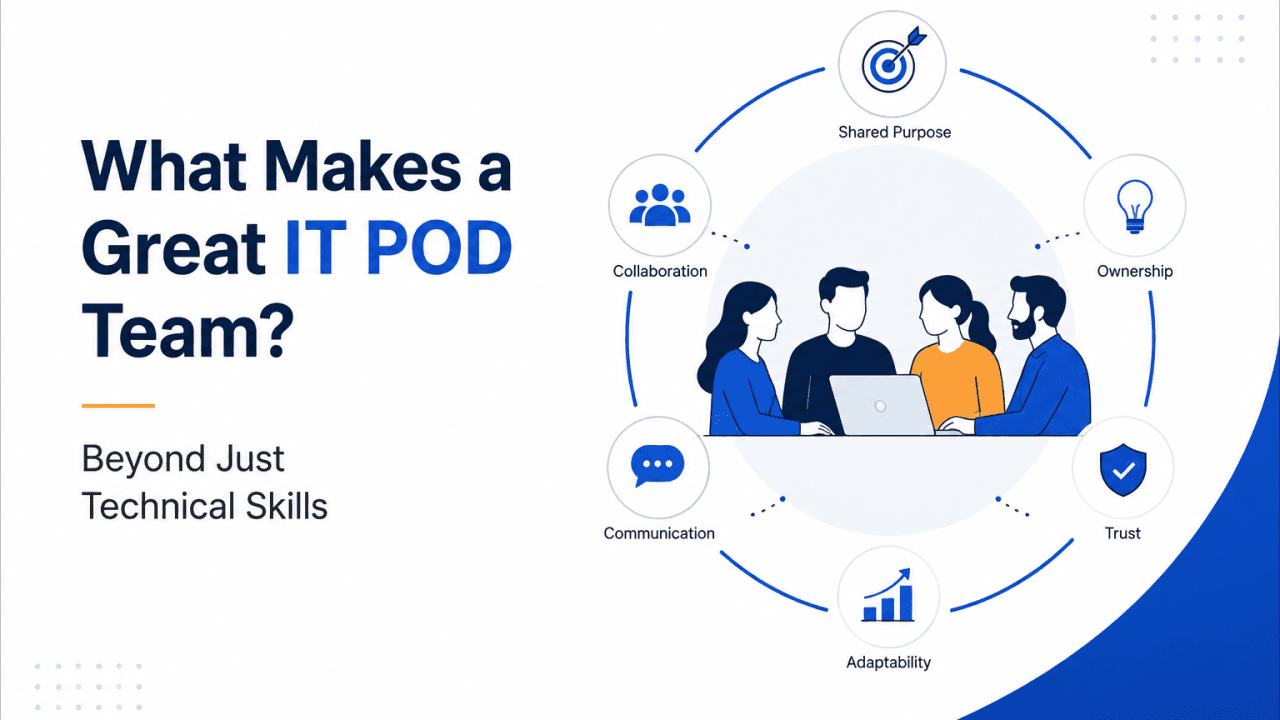
People naturally perform better when they experience:
● Clear ownership
● Faster feedback
● Smaller communication loops
● Emotional connection to outcomes
● Trust inside the team
POD teams create these conditions naturally.
● Because the team is smaller, every contribution becomes visible.
● Because responsibilities are clearer, accountability increases.
● Because collaboration is tighter, trust develops faster.
And when trust increases, performance improves.
Research on Agile productivity also highlights that team collaboration, self-organisation, and reduced interpersonal friction directly impact delivery performance.
In simple terms:
People work differently when they feel like owners instead of resources.
That psychological shift is one of the biggest reasons POD models outperform traditional structures.
Real Business Benefits of POD-Based Scaling
Organisations adopting POD models are seeing measurable improvements in multiple areas:
● Faster Time-to-Market
● Better Product Quality
● Higher Team Accountability
● Improved Client Satisfaction
● Easier Scaling
Some modern engineering studies even report higher productivity and fewer production incidents in well-structured POD environments.
Common Mistakes Companies Make When Scaling Tech Teams
Even strong companies make scaling mistakes.
The most common ones include:
● Hiring Faster Than Processes Can Handle
● Creating Too Many Dependencies
● Measuring Activity Instead of Outcome
● Ignoring Team Psychology
The most successful technology organisations focus less on “team size” and more on “delivery flow.”
That is a major mindset shift
Why POD Models Are the Future of IT Delivery
The future of technology delivery is not about building the biggest teams.
It is about building the most adaptive teams.
Modern businesses need structures that can:
● Respond quickly
● Scale efficiently
● Reduce waste
● Maintain quality
● Adapt continuously
POD models align perfectly with these needs.
They combine the speed of startups with the operational discipline of enterprise delivery.
And as AI, automation, and digital transformation continue reshaping industries, companies that can move faster without creating internal complexity will have a major advantage.
That is exactly why POD-based delivery is no longer a trend.
It is becoming the new standard.
Conclusion: Scale Smarter, Not Heavier
POD models are changing how businesses think about delivery because they solve three critical challenges simultaneously:
● Flexibility
● Speed
● Cost efficiency
But beyond the operational benefits, POD models solve something even more important:
They create environments where people collaborate better, take ownership naturally, and deliver with purpose.
And in technology, human performance is still the biggest competitive advantage of all.
Explore Related NRT Services
Continue from this insight into NRT Group delivery areas that support enterprise technology teams.
Frequently Asked Questions
Common questions related to this article.
What is a POD model in IT services?+
POD model is a small, cross-functional, self-managed team that includes developers, QA engineers, designers, DevOps specialists, and other experts working together to deliver a specific product, feature, or business outcome more e
How do POD models improve software delivery speed?+
POD models reduce dependencies and communication delays by bringing all required skills into one team. This enables faster decision-making, quicker releases, and more efficient issue resolution.
Why are POD models more cost-effective than traditional team structures?+
POD models focus on lean, outcome-driven teams, reducing management overhead and unnecessary coordination. This helps businesses optimize resources, improve productivity, and scale projects without significantly increasing costs.
Ashok Sahu
CTO