A post for tech leaders, product teams, and everyone who's ever watched a well-funded project quietly fall apart.
Here's something that should make every CTO and project sponsor pause.
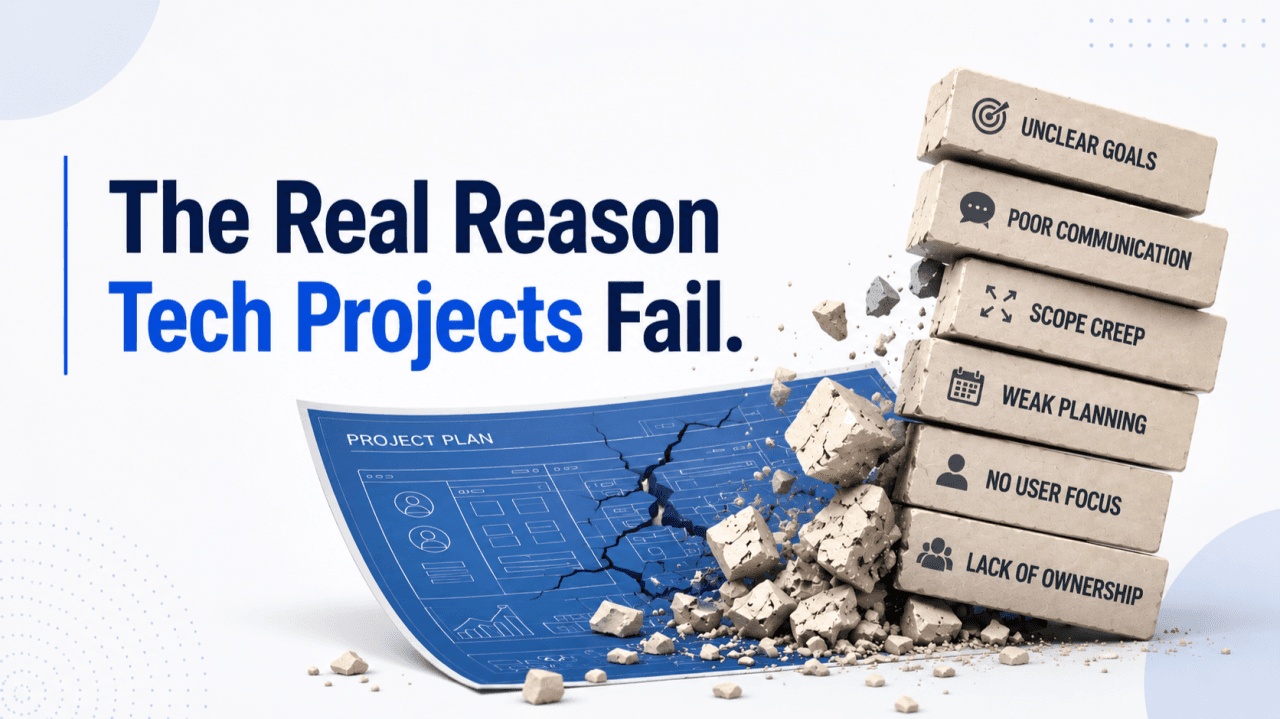
The Standish Group analysed over 50,000 technology projects globally — and found that 66% ended in partial or total failure. Not because teams lacked talent. Not because the technology didn't work. But because something more fundamental broke down long before the first line of code was written.
We keep blaming skill gaps. We keep hiring more engineers. We keep buying better tools.
And yet, the numbers don't budge.
The Real Problem Is Hiding in Plain Sight
Ask any project post-mortem what went wrong, and you'll hear familiar answers: "poor communication," "unclear requirements," "stakeholder misalignment."
We nod. We document it. And then we do the same thing again.
BCG's research cuts to the core of why: "Technology leaders speak a very different language than business department managers." That gap — between the people who build and the people who decide — is where most projects actually die.
A BCG survey found that when technology leaders were actively involved from the beginning of strategy development, project success rates were 154% higher than in projects where they weren't. Not 10% higher. Not 20%. 154%.
That's not a skill gap. That's a leadership and alignment gap.
The Psychology Nobody Talks About
Here's where it gets interesting — and a little uncomfortable.
When a project starts, everyone in the room thinks they're aligned. The business team has a vision. The tech team has a plan. Leadership has a deadline. Everyone nods. Everyone leaves the meeting feeling good.
But what's actually happening is that three different groups are carrying three different mental models of what success looks like. And nobody has bothered to check if those models match.
Cognitive psychology calls this the common knowledge problem — teams tend to discuss what everyone already knows and agrees on, while the critical information that only some people hold (the real risks, the uncomfortable trade-offs, the operational realities) stays buried. Research from Nielsen Norman Group confirms that in team environments, dissenting or unique information is chronically underweighted, especially when the environment feels unreceptive to pushback.
Add to this the optimism bias — our natural tendency to believe our project will beat the odds — and you have a recipe for confident, well-intentioned teams walking straight into avoidable failure.
Leadership Misalignment Is the Multiplier
Prosci's 2025 research on ERP implementations revealed something that should be mandatory reading for every executive sponsor: resistance to change doesn't just come from end users. It comes from leaders.
And leadership resistance disproportionately impacts outcomes.
When executives are visibly disengaged, hesitant, or quietly sceptical of a project, their teams notice. Nobody says anything. The scepticism doesn't show up in a status report. But it spreads — through delayed decisions, half-hearted adoption, and teams that stop raising red flags because they sense no one is really listening.
Prosci documented a specific case where simply replacing a resistant executive sponsor with an engaged one turned around a failing SAP deployment. Same team. Same technology. Different leadership alignment. Different outcome.
This is the human variable that no tool, no framework, and no sprint ceremony can fix.
The Cost of Getting This Wrong
Let's talk numbers, because this is not an abstract problem.
● 70% of digital transformation initiatives still fail to meet their objectives, costing organisations an estimated $2.3 trillion per year globally (Gartner).
● 88% of business transformations failed to achieve their original ambitions, according to Bain's 2024 study.
● For AI specifically, MIT's 2025 report found a 95% failure rate for enterprise generative AI pilots — with misaligned expectations cited as a primary cause.
The pattern is consistent across industries, project types, and budget sizes. Technology is rarely the bottleneck. Alignment is.
IDC's research on digital transformation echoes this: the most common failure driver is misalignment between technology initiatives and business objectives — compounded by inadequate planning and siloed thinking.
What Aligned Teams Actually Look Like
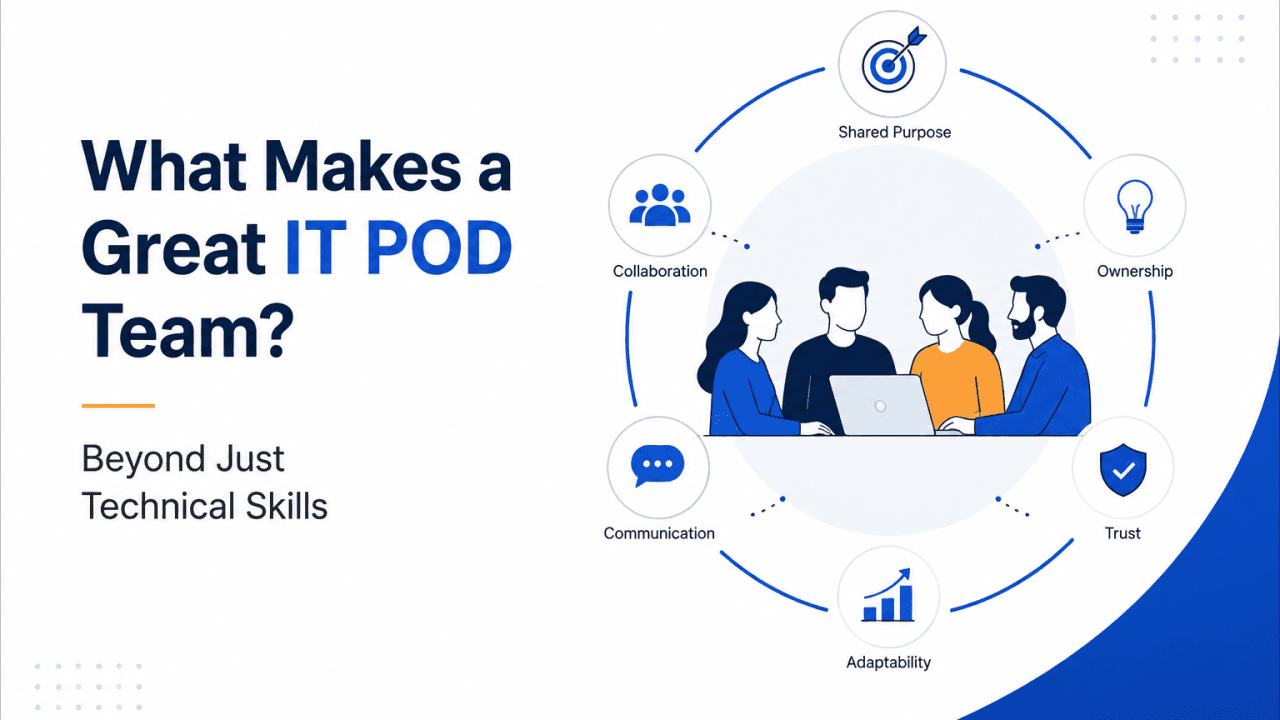
The POD (Product-Oriented Development) model offers one practical answer to this problem — not just as an organisational structure, but as a deliberate response to the misalignment crisis.
A well-structured IT POD brings together developers, designers, QA engineers, a product manager, and a technical lead into a self-contained, cross-functional unit with shared ownership of outcomes. The distinction matters: PODs aren't just about skills coverage. They're about eliminating the distance between decision-making and delivery.
When designers and engineers share ownership of the problem space — not just their individual tasks — the dynamic shifts. Teams make decisions faster, surface risks earlier, and don't need to wait for inter-department approvals to resolve blockers. The weekly cadence creates a natural rhythm of visibility: everyone knows what was built, what's next, and why it matters.
Organisations like Spotify have credited this structure — they call it "squads" — with much of their product velocity and capacity for innovation. The reason isn't technical. It's psychological: when people feel genuine ownership, they behave differently.
Three Things Leaders Can Do Differently
The research points to some clear, practical actions:
1. Align before you build. Don't start sprint planning until business goals, technical constraints, and success metrics are explicitly agreed upon — in writing, by all stakeholders. Vague alignment at the start becomes expensive misalignment at the end.
2. Make leadership engagement non-negotiable. An executive sponsor who shows up only for quarterly reviews is a liability, not an asset. Prosci's data is clear: visible, engaged sponsors dramatically improve adoption and outcomes. Build that expectation into your project governance from day one.
3. Create psychological safety for bad news. The projects that recover quickly are the ones where teams feel safe saying "this isn't working." That doesn't happen by accident. It requires deliberate norms — honest retrospectives, leadership that responds to problems without shooting the messenger, and a culture where raising a risk is rewarded, not penalised.
Your tech team is probably good enough. The technology you're using is probably capable enough.
The question worth asking isn't "do we have the right skills?" It's "do we have the right alignment — between strategy and execution, between business and technology, between what leadership says matters and what the team is actually being measured on?"
Most projects don't fail at the keyboard. They fail in the meeting room, or the hallway conversation that never happened, or the assumption that was never tested.
Fixing that is a leadership problem. And it's entirely solvable.
Explore Related NRT Services
Continue from this insight into NRT Group delivery areas that support enterprise technology teams.
Ashok Sahu
CTO