
For CIOs, CTOs, and every tech leader quietly questioning whether the way they're building teams still makes sense.
Here's a question worth sitting with for a moment.
When did "more people" become the default answer to "how do we deliver faster"?
It's an easy assumption to make. Bigger budget, bigger team, bigger output. But the evidence — and the experience of the world's best technology organisations — tells a very different story.
The future of IT delivery isn't bigger. It's smaller, sharper, and radically cross-functional.
The Old Model Is Breaking Under Its Own Weight
The traditional IT delivery model was built for a different era. Separate teams for development, design, QA, and operations. Formal handoffs at each stage. Approvals that cascade upward before anything moves. It was designed for predictability — but it's delivering something else entirely.
McKinsey research on siloed operations found that friction costs from disconnected teams typically consume 20–30% of organisational capacity. One manufacturing company analysed a single product launch process and found it required 41 separate handoffs between departments, with an average delay of 3.7 days per handoff. Each handoff costs an estimated $27,000 in direct and indirect expenses.
That's not a bottleneck. That's a structural tax on everything the organisation tries to build.
IDC research puts a sharper number on it: companies lose 20–30% of their annual revenue to inefficiencies caused by organisational silos. For a $10 million business, that's up to $3 million disappearing into coordination overhead every year — not bad decisions, not bad technology, just bad structure.
The irony is that most organisations know this. And yet the default response when a project is struggling is still to add more people, more meetings, and more process — which only makes the problem worse.
Why Bigger Teams Don't Solve the Problem
There's a reason the most admired technology companies in the world deliberately keep their delivery teams small.
Jeff Bezos made it a rule at Amazon: no team should be so large that it can't be fed by two pizzas. Typically, 5–8 people. Not because of budget constraints — because of what happens to productivity and ownership as team size grows.
The science behind it is unambiguous. Researchers Staats, Milkman, and Fox gave identical tasks to small and large teams. The larger teams took 44% longer to complete the same work. And here's the uncomfortable part: the larger teams were actually more optimistic about how long they'd need — a reminder that team size inflates confidence while quietly eroding output.
AWS describes the underlying dynamic clearly: as team size grows, something called the Ringelmann Effect kicks in — individual productivity decreases because people unconsciously rely on others to carry the load. The result is a team that feels productive but delivers less per person than a smaller, tighter unit would.
The counterintuitive truth: small teams aren't a budget compromise. They're a performance choice.
What McKinsey's 2026 Research Actually Says
This isn't just startup wisdom or tech folklore. McKinsey's Global Tech Agenda 2026 — based on a survey of over 600 technology and business leaders — identifies a structural divide between companies that are simply modernising their IT and those genuinely competing at speed.
The finding is direct: top-performing companies have shifted from treating technology as a cost centre to treating it as a value creator. And the structural change driving that shift is the move toward product and platform operating models — where decisions happen within days instead of months, handoffs drop, and information flows faster.
McKinsey's AI Transformation Manifesto is even more pointed: "Speed is the defining organisational advantage." Companies win the innovation race not by having better technology access — everyone has access to the same tools — but by being able to redeploy resources faster, empower teams to act without excessive dependencies, and reduce the latency from insight to decision.
The report recommends what they call the "30–70 shifts": more than 70% of tech talent should be in-house, performing at higher skill levels, in small and highly skilled teams. The conclusion? Small, highly skilled teams outperform large armies of lower-skilled staff — consistently, measurably, and structurally.
Cross-Functional Is the Missing Ingredient
Small teams only work if they're genuinely cross-functional.
A small team of five developers doesn't move faster than a large one — they just have fewer people waiting on the same bottlenecks. The transformation happens when you put the designer, the developer, the QA engineer, the product manager, and the technical lead in the same unit, with shared ownership of the outcome.
Monday.com's 2026 research on cross-functional collaboration frames the imperative well: AI initiatives and rising customer expectations now require real-time coordination across IT, operations, and business units. Organisations that master cross-functional execution will outpace competitors still trapped in departmental silos. The path forward requires intentional design of workflows, communication systems, and performance metrics that reward collaborative behaviour.
Medium's analysis of 2025 Agile delivery trends confirms the shift is already underway: Agile frameworks that began in IT are now being adopted by marketing, HR, and finance teams — because the core insight that isolated teams hinder progress applies everywhere, not just in software.
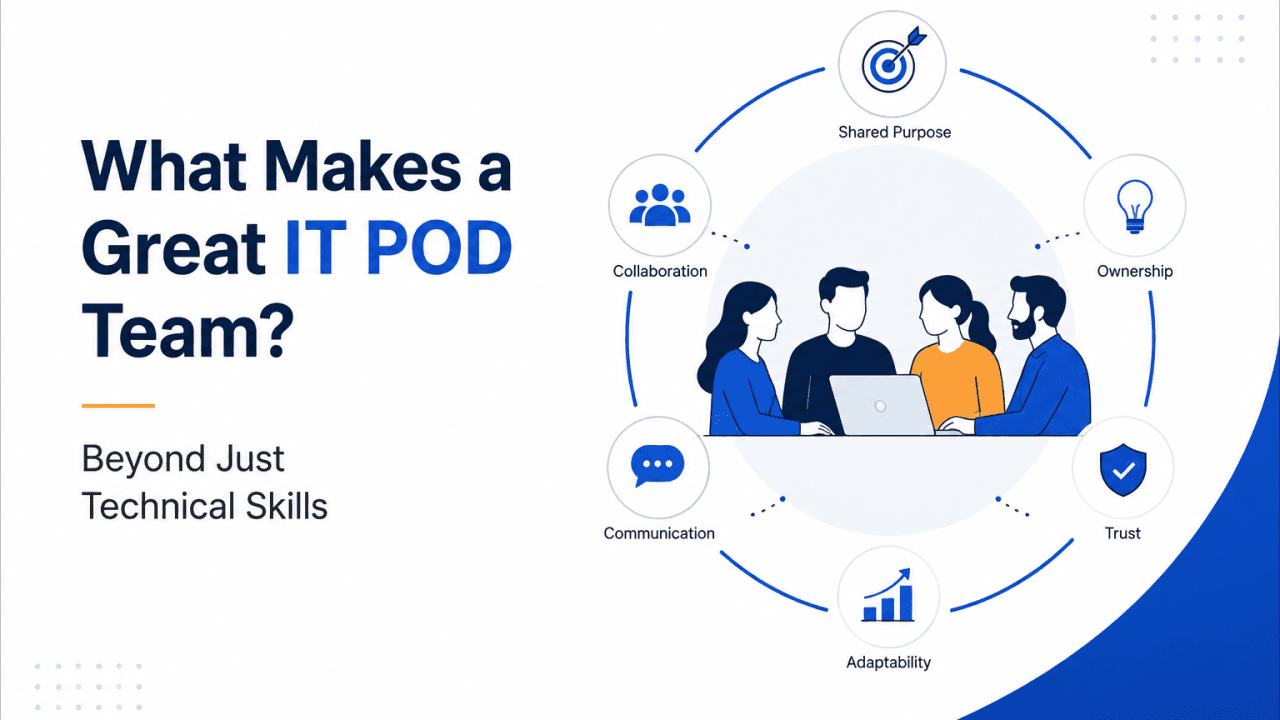
The POD model (Product-Oriented Delivery) is the structural expression of this principle. A cross-functional pod owns a product or feature end-to-end — from design to development to deployment. No waiting for another team's input. No approval chains that stretch across departments. The team has everything it needs to ship, and it's accountable for whether it does.
The Psychology of Small: Why This Goes Deeper Than Org Charts
There's something that numbers and org charts can't fully capture: what it feels like to be on a small, focused, cross-functional team that actually owns something.
When a team is small enough that every person's contribution is visible, people show up differently. AWS's research on two-pizza teams found that smaller teams consistently show higher engagement and individual ownership, which directly translates to faster delivery and better quality.
Compare that to a large team working on a massive platform where individual contributions blur into the background. Nobody feels the weight of a missed deadline the same way. Nobody feels the pride of a shipping feature the same way, either. The psychological distance between "my work" and "the outcome" grows — and so does the time it takes to deliver.
This is why the cross-functional teams' research from TeamForm identifies curious minds and adaptability as more important hiring criteria than specific technical skills alone. The future of IT delivery isn't just about what people can do — it's about how quickly they can learn, collaborate, and take ownership in a small team environment.
The CIO's Changing Role
This shift has a direct implication for technology leadership.
McKinsey's 2026 Global Tech Agenda found that two-thirds of top-performing companies have technology leaders "very involved" in crafting enterprise strategy — compared with just 52% of other organisations. CIOs are no longer managing infrastructure. They're architecting the operating model that determines how fast the business can move.
That responsibility includes making structural decisions about how teams are built. An organisation with ten large, siloed teams will always move more slowly than one with twenty small, focused, cross-functional pods — not because of individual skill differences, but because of the structural properties of how work flows through each model.
The leaders who understand this aren't just adjusting their team charts. They're redesigning how decisions get made, how accountability is distributed, and how quickly their organisations can go from a customer insight to a shipped solution.
What This Looks Like in Practice
The shift from large, siloed teams to small, focused, cross-functional pods doesn't happen overnight — but it doesn't have to be a full organisational overhaul either.
The most effective transitions start with a deliberate pilot: identify your highest-priority product area, form a dedicated cross-functional pod around it, give it genuine ownership and decision-making authority, and measure the results against your existing delivery model. The contrast tends to be instructive.
Connext Global's 2026 research on hybrid dedicated team models found that companies shifting from fragmented freelance structures to dedicated team models reported a 34% improvement in project delivery timelines and a 41% reduction in rework costs within the first 12 months. These gains came not from hiring better people, but from changing how those people were organised and who they were accountable to.
That's the proof point most organisations need: the same talent, differently structured, producing dramatically better outcomes.
The Direction of Travel Is Clear
The signals are consistent across research, practice, and competitive outcome.
Gartner identifies cross-functional teams as central to managing emerging technology risk and capturing value from AI and automation. McKinsey says speed — powered by small, autonomous, cross-functional teams — is the defining organisational advantage. The fastest-growing technology companies have been running this playbook for years.
The question for every IT leader reading this isn't whether cross-functional, focused teams are the future. They clearly are.
The question is: when does your organisation start building that way?
Explore Related NRT Services
Continue from this insight into NRT Group delivery areas that support enterprise technology teams.
Frequently Asked Questions
Common questions related to this article.
Why are small cross-functional teams often more effective than large IT teams?+
Small cross-functional teams reduce communication delays, eliminate unnecessary handoffs, and encourage greater ownership. With developers, designers, QA engineers, and product managers working together, they can make faster decisions and deliver features more efficiently.
What is a Product-Oriented Delivery (POD) model?+
A POD model organizes a small, dedicated team around a specific product or feature. Each pod includes the skills needed to take work from planning and design through development, testing, and deployment, enabling end-to-end accountability and faster delivery.
How can CIOs and CTOs transition to a POD-based approach?+
Technology leaders can start by creating a pilot cross-functional pod for a high-priority project, giving it clear ownership and decision-making authority, then comparing its speed, quality, and outcomes with traditional siloed team structures.
Ashok Sahu
CTO