For every founder who's felt the clock ticking, and every enterprise leader who's watched a competitor ship first.
Speed is no longer just a tech advantage. It's the baseline.
The window between "we had this idea first" and "someone else already shipped it" has never been narrower. And yet, most organisations — startups and enterprises alike — are still building products the way they did ten years ago: siloed teams, sequential handoffs, approval chains that slow everything down.
The result? Global software spending is projected to hit $1.23 trillion in 2025, up 14% from 2024 — but the teams receiving that investment are still moving too slowly to fully capitalise on it.
Something has to change structurally.
The Speed Problem Hits Differently Depending on Where You Sit
For startups, slow execution is existential.
90% of startups eventually fail, and the top reasons aren't technical mysteries: 42% fail due to lack of market need, 29% run out of cash, and 23% cite not having the right team. These aren't random accidents. They're what happens when a team can't move fast enough to learn, adapt, and find product-market fit before the runway ends.
For enterprises, the stakes are different but equally real. Large organisations often have the talent and the budget — but they're trapped in structures that turn a two-week feature into a two-month approval cycle. By the time a decision reaches the right person, the market has moved.
McKinsey's research on digital transformation is direct on this point: no company can outsource its way to digital excellence, and scaling to support agile delivery requires a fundamentally different operating model — one built around autonomous, cross-functional teams.
The question is: what does that actually look like in practice?
What a POD Is — and Why the Structure Matters
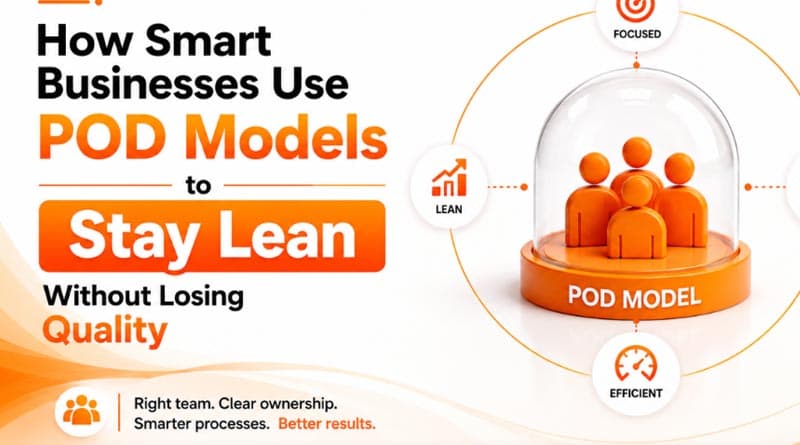
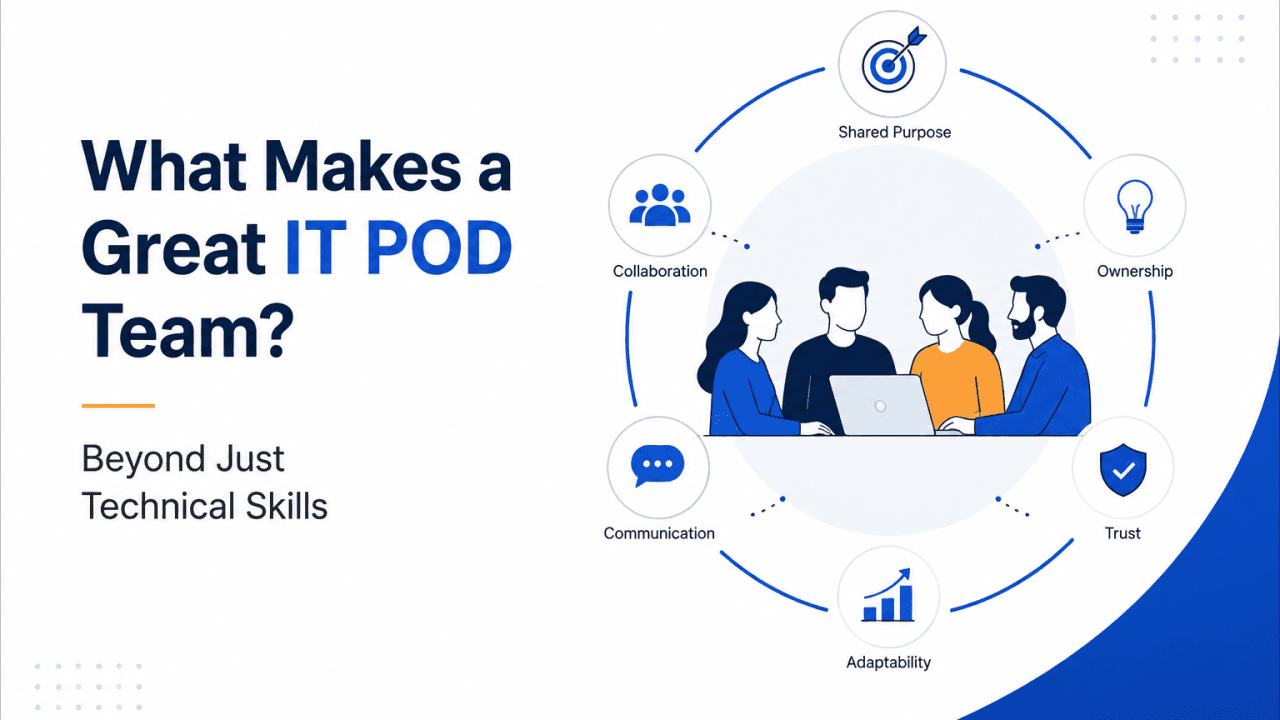
A POD (Product-Oriented Delivery) team is a small, self-sufficient unit — typically 4–8 people — that owns a product or feature end-to-end. Developers, designers, QA engineers, a product manager, and a tech lead working together as one cohesive unit, not as separate departments that pass work to each other.
The structure isn't just organizationally tidy. It's psychologically different.
Traditional teams have dependencies. A designer waits for a brief. A developer waits for a design. QA waits for a build. Every handoff is a potential delay, a lost context, a miscommunication waiting to happen.
PODs eliminate most of those handoffs by putting everyone in the same room — metaphorically or literally. When the person who designed the feature sits next to the person building it, problems get caught earlier, decisions get made faster, and nobody is waiting on a reply to an email.
Innova Solutions puts a number on this: what takes three months in a traditional model can often be done in three weeks with an agile POD. That's not a marginal gain. That's a structural change in how fast a company can learn and iterate.
The Data Behind the Speed
This isn't anecdotal. The research is consistent.
Agile teams are nearly 25% more productive than non-agile counterparts and 50% faster to market. Those numbers come from a period when Agile adoption in software teams grew from 37% to 86% — driven precisely because the productivity gap was too large to ignore.
When you add the POD structure on top of Agile methodology, the acceleration compounds:
● Accenture's research on scaled POD implementations found that organisations achieve up to 40% faster product delivery and a 25% improvement in stakeholder alignment.
● McKinsey's work on agile team performance shows a 20–30% increase in productivity and measurably faster time-to-market.
● Businesses that implemented marketing PODs saw a 5–10% boost in ROI within months, and teams that could launch, test, and optimise without waiting on external designers or engineers.
These aren't isolated case studies. They reflect a pattern: when you give a small team clear ownership and the skills to execute independently, they move faster — and the work is better.
Why Startups Specifically Need This Model
For a startup, speed is survival.
The founding team is usually lean. There's no room for a development team that waits on a design team that waits on a product team. Every week of delay is a week of burn rate, a week where a competitor could be shipping.
The POD model fits the startup context almost naturally — because good startups already operate this way in the early days. Everyone does everything. The problem comes as they scale: roles get more defined, silos form, and suddenly the company that moved at startup speed is moving like a mid-sized enterprise.
Structuring growth around PODs from the start — or adopting them deliberately during scaling — preserves the execution speed that made the company competitive in the first place.
The Spotify "squad" model is the most cited example of this done right: small, autonomous teams with clear ownership, organised around outcomes rather than functions. The result was a company that could ship continuously at scale — something most organisations of that size struggle to do.
Why Enterprises Need This Model Too
Enterprises have a different problem. They have enough people. They just have too many layers between a decision and a delivery.
McKinsey's research on the product and platform operating model identifies cross-functional teams as the core structural requirement for digital transformation. Not as a nice-to-have. As the operating system.
The reason large companies are slow isn't usually that their engineers aren't skilled. Is it that a feature request has to pass through five departments, two approval meetings, and a backlog prioritisation process before anyone writes a line of code? PODs cut through that by creating a unit with the authority to make decisions at the team level.
Deloitte's acquisition of HashedIn Technologies illustrated this clearly: it was a deliberate move toward pod-based agile methodologies specifically to speed up cloud innovation. Same principle at the organisational level — bring the capabilities together, reduce the distance between decision and delivery.
The Psychology of Ownership — and Why It Changes Everything
Here's something the velocity metrics don't fully capture: when people own outcomes rather than tasks, they show up differently.
A developer who's responsible only for writing code can write good code and consider their job done. A developer who's part of a POD that owns a product — its quality, its delivery timeline, its customer feedback — is invested in whether the thing actually works.
This isn't a management theory. It's backed by research. Google's UX-POD model, which brought together UX researchers, designers, and frontend developers into unified teams, accelerated product launches precisely because the team cared about the result, not just their individual contribution.
Ownership creates accountability. Accountability creates urgency. Urgency creates speed. That chain doesn't happen in a siloed structure — because the accountability is diffuse, and no single person or team feels the weight of whether the product ships on time or not.
What This Looks Like in Practice for Your Business
Whether you're a founder trying to hit your next milestone or an enterprise leader trying to break through internal inertia, the practical application is the same:
For startups: Structure your team around products and outcomes from the start. Don't wait until you're large enough to need a formal process — by then, the silos are already forming. A dedicated POD for your core product gives you startup speed with a more scalable foundation.
For enterprises: Identify the one or two product areas where speed matters most competitively. Pilot a POD there. Give it genuine ownership — not just a cross-functional label but real decision-making authority. Measure time-to-market before and after. The results will make the case for broader adoption better than any internal presentation.
For both: The goal isn't the POD itself. The goal is to reduce the distance between a customer's need and a shipped solution. PODs are the structural answer to that problem — but they only work if the team has clarity on what they're building, why it matters, and who makes the call when things change.
The Competitive Reality in 2026
Software investment is growing at 14% year over year. Enterprise AI adoption jumped from 55% to 75% in a single year, with companies reporting an average 3.7× ROI on generative AI investments. The pace of technology change isn't slowing down — it's accelerating.
In that environment, the companies that win aren't necessarily the ones with the biggest budgets or the most engineers. They're the ones who can learn the fastest, ship the most reliably, and adapt the most quickly when the market shifts.
POD services exist precisely for that competitive reality — built for speed, precision, and the kind of cross-functional collaboration that turns strategy into shipped product.
The question isn't whether you need to move faster. You do. The question is whether your current team structure will let you.
Explore Related NRT Services
Continue from this insight into NRT Group delivery areas that support enterprise technology teams.
Frequently Asked Questions
Common questions related to this article.
What is a POD team in software development?+
POD (Product-Oriented Delivery) team is a small, cross-functional group of professionals that typically includes developers, designers, QA engineers, and product managers working together to own a product or feature from planning to deployment. This structure reduces communication gaps, speeds up decision-making, and enables faster product delivery.
Why are POD services beneficial for startups and enterprises?+
POD services help startups accelerate product launches, validate ideas quickly, and adapt to market feedback while conserving resources. For enterprises, PODs break down organizational silos, improve collaboration across departments, and reduce time-to-market by giving dedicated teams end-to-end ownership of product development.
How do POD teams improve software development speed and efficiency?+
POD teams improve efficiency by eliminating unnecessary handoffs between departments and enabling real-time collaboration among all stakeholders. With clear ownership, faster communication, and agile workflows, businesses can release features more quickly, respond to customer needs faster, and maintain higher product quality.
Ashok Sahu
CTO